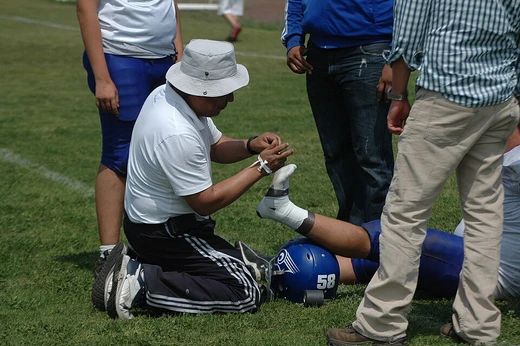
Concussions in Australian sport
Concussions in Australian sport pose serious risks across all levels.
Concussions in Australian sport are a significant and growing concern, particularly in high-impact codes such as Australian rules football and rugby. Defined as a temporary loss of consciousness or confusion caused by a blow to the head, concussions fall under Traumatic Brain Injury (TBI) and pose serious threats to players' mental and physical health, as well as their playing careers. Repeated concussions or returning to play too soon can lead to lasting brain damage, depression, and severe brain swelling, making proper management and medical clearance essential at all levels of competition.
- AFL concussion rate
- 5–6 per 1000 hours of play
- AFL concussions per team per season
- 6–7
- Rugby professional concussion rate
- 3.9 per 1000 hours (1 in 6 games)
- Rugby amateur concussion rate
- 1.2 per 1000 hours (1 in 21 matches)
- Rugby concussions per team per season
- 5–7
- Amateur AFL concussion rate (2002 study)
- 18.9% of 301 players
- Cricket junior facial injury rate
- 13% (no concussions reported)
Lore & Background
In Australian rules football, head injuries have always been common, but public awareness has increased over the last decade. The AFL introduced a 20-minute concussion test in 2013 and a mandatory 12-day rest period in 2021, unless cleared by an experienced doctor. Despite these measures, a 2026 report revealed that the Geelong Football Club and player Jake Kolodjashnij signed a waiver absolving the club from liability for future concussions, prompting public backlash and an AFL 'please explain'.
Reader's Guide
Concussions in Australian sport are most prevalent in contact sports like Australian rules football and rugby, where repeated head impacts are common. The AFL estimates 5–6 concussions per 1000 hours of play, while rugby sees 3.9 per 1000 hours at the professional level. Amateur levels often have fewer resources, making concussions potentially more dangerous. Cricket, though less continuous, still poses risks due to high-speed balls, leading to the introduction of concussion substitutes in domestic competitions in 2016 and internationally in 2019. The long-term significance lies in the ongoing evolution of guidelines—such as mandatory rest periods and medical assessments—to protect players from lasting brain damage. The 2026 Geelong waiver controversy highlights tensions between player safety and club liability, underscoring the need for independent oversight. Concussion management remains a critical issue, with research and policies continuously updated to mitigate risks.
Did You Know?
- In the AFL, a player suspected of concussion must take a 20-minute test (introduced in 2013) and cannot play for 12 days unless cleared by an experienced doctor (introduced in 2021).
- In 2026, the Geelong Football Club and player Jake Kolodjashnij signed a waiver absolving the club from liability for future concussions, leading to public backlash and an AFL 'please explain'.
- Cricket introduced concussion substitutes in domestic competitions in 2016 and internationally in 2019, with Steve Smith becoming the first player substituted under the ICC rule in the 2019 Ashes.
- A 2002 study of amateur Australian rules football players found that 18.9% of 301 participants suffered a concussion.
The Medical Reality of Concussion
Concussion sits at the intersection of sport and serious medicine. Classified as a form of Traumatic Brain Injury, it is defined as temporary unconsciousness, confusion, or other symptoms triggered by a blow to the head. In Australian sport, head injuries represent the most dangerous category of injury across every level—from junior clubs to elite professional competition—and their frequency is climbing. The immediate aftermath of a single concussion often includes headache, dizziness, memory lapses, blurred vision, disorientation, and heightened sensitivity to light and sound. These symptoms are manageable and, in isolation, rarely life-threatening. The true peril emerges when a player sustains repeated concussions or returns to the field before full recovery. In those cases, the risk escalates dramatically: a second blow becomes far more severe, reaction times slow across the whole body, and the player faces the spectre of permanent brain damage, severe cerebral swelling, and psychological complications including depression. Crucially, the visible warning signs—loss of consciousness, unsteadiness, poor coordination, a vacant or dazed expression, or confusion about one's surroundings—only carry meaning after a head strike has occurred, making timely recognition by coaches and teammates essential.
AFL's Evolving Concussion Protocol
Australian rules football, with its relentless high-impact collisions, has long been a breeding ground for head injuries. The numbers are stark: for every 1,000 hours on the field, five to six players suffer a concussion—roughly six or seven per club in a single season. For years, a troubling culture persisted at the elite level—players who suspected they had been concussed would deliberately conceal the injury from coaches, fearing they would be benched. The AFL has worked to dismantle that culture. New concussion management guidelines now require that only a medical officer with relevant experience can clear a player to return, and coaches are explicitly cautioned against rushing athletes back into the lineup. In 2013, the league introduced a mandatory 20-minute concussion test for any player suspected of suffering a head knock. A further tightening came in 2021, when a new rule mandated that a concussed player must sit out for at least 12 days before being eligible to play again, unless an experienced physician certifies them fit. The overarching principle is clear: no player, at any age or competition tier, may resume training or match play without formal medical clearance from a registered doctor.
The Grassroots Gap and What Research Reveals
While elite AFL clubs now operate under structured concussion protocols, the amateur and junior tiers of Australian football remain a vulnerable frontier. Resources are thinner, medical support is less consistent, and in some cases coaches simply refuse to remove a player they believe is concussed, exposing that athlete to the compounded dangers of repeated head trauma. Research has begun to quantify the problem. A 2002 study by the Australian Football Injury Prevention Project examined 301 players from Melbourne metropolitan amateur clubs and found that 14 sustained some form of head knock, seven of which met the threshold for concussion—meaning roughly 18.9% of the sample experienced a concussive event, a striking figure even accounting for the modest sample size. A separate, larger investigation of 1,015 Australian rules football players identified 78 concussions, with nine players suffering multiple episodes. Mental-function testing conducted at controlled intervals revealed that 38.6% of concussed players still exhibited symptoms at the 48-hour mark, though by 96 hours that figure had dropped to just 1.1%. These findings underscore that recovery is not instantaneous and that the amateur environment, with its limited access to specialist assessment, may be the setting where concussions go most dangerously unmanaged.
Cricket's Approach and the 2026 Geelong Controversy
Cricket occupies a unique position in the concussion conversation. While its stop-start rhythm sets it apart from continuous-flow codes, fast-bowling velocity and ball hardness make it a high-impact sport. Batsmen rely on the most extensive protective gear in Australian sport, the helmet and face grill being the primary shield. Concussion in cricket is considered rare thanks to safer helmet design, yet the consequences are no less serious. During a 2015 West Indies tour, Australian batsman Chris Rogers sustained a concussion in training and was ruled out of the entire Test series. That incident prompted Cricket Australia to develop updated guidelines modelled on the Zurich Guidelines, requiring a suspected player to answer structured questions to determine whether they must leave the field. Separately, an August 2026 News Corp report revealed that Geelong had signed a liability waiver with active player Jake Kolodjashnij, absolving the club of responsibility for future concussions. The disclosure triggered severe public backlash and calls for an independent investigation. The AFL and AFL Players Association acknowledged the report without suggesting wrongdoing, but the following week the AFL issued Geelong a "please explain" notice amid expectations of a substantial sanction.
Frequently Asked Questions
What counts as a concussion in Australian football or rugby?
A concussion in Australian sport is a temporary episode of confusion or loss of consciousness caused by a direct blow to the head, and it is classified under the broader category of Traumatic Brain Injury.
How often do AFL players get concussed during a season?
The AFL concussion rate sits at roughly five to six per 1,000 hours of play, which translates to about six or seven concussions per team in a typical season.
What happens if a player returns to play too soon after a concussion?
Premature return to the field can trigger lasting brain damage, severe brain swelling, and long-term depression, which is why full medical clearance is mandatory before an athlete resumes competition.
Are concussions more common in professional rugby than in amateur rugby?
Yes—professional rugby sees a rate of about 3.9 concussions per 1,000 hours (roughly one in six games), while amateur rugby records a much lower rate of 1.2 per 1,000 hours, or about one in twenty-one matches.
Why do Australian sports codes need strict concussion management protocols?
Because repeated head impacts and inadequate recovery carry risks that extend across a player's entire mental and physical health as well as their career, proper management and medical oversight are essential from grassroots to professional levels.
More in Sports injuries 1-24
Spotted an error? Know more?
This is a living reference — every entry is fact-audited, and reader corrections feed straight into our audit queue. Suggest an edit · See this site's audit record